News Story
A Longer Life for Lithium Ion Batteries
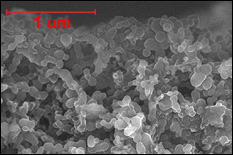
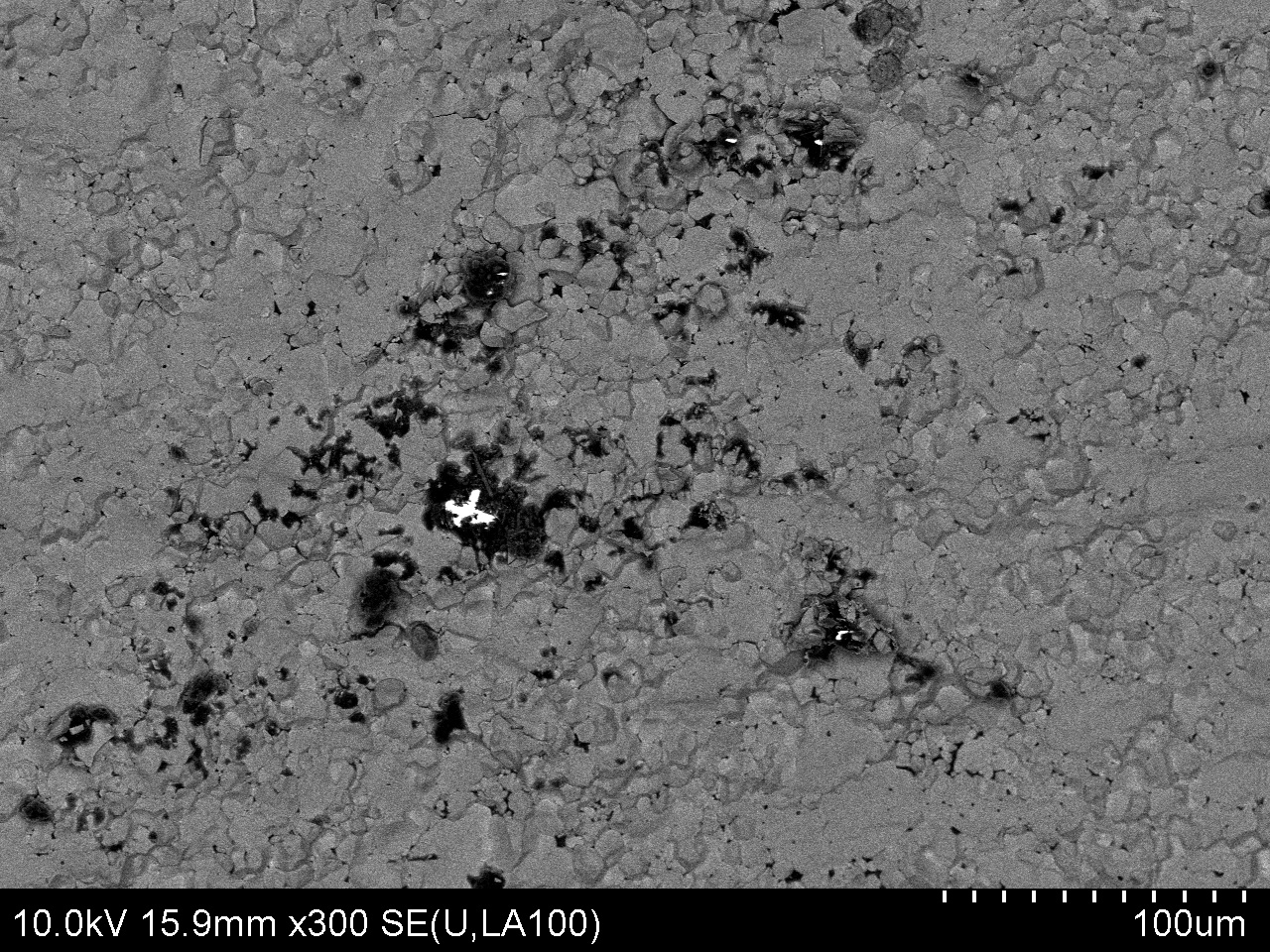
A scanning electron microscope (SEM) image of a cross-section of Guo and Wang's silicon scaffold anode.
Rechargeable Li-ion batteries are used in a wide range of products and equipment, and have shown potential for use in electric vehicles. But before that can happen, Guo says, they need to be more durable and store and put out more power.
"A current challenge to developing lithium ion batteries with higher energy is replacing the current low capacity negative electrode, which is made of graphite, with a new material with a much higher capacity," he explains. "Silicon is a good candidate in terms of its capacity, which is ten times higher. However, the great shortcoming of silicon is that during the charge/discharge process, silicon particles undergo large changes in their volume as the lithium ions are inserted and extracted. This causes a lot of stress, and as a result the silicon particles will eventually be pulverized, and the battery's electrode structure will be demolished."
Most previous research on this problem focused on the nano-sized silicon particles themselves, or silicon nanowires, but improvement was limited. Guo and Wang came up with a different approach.
"The idea was to incorporate nano-size silicon particles into a 3D scaffold structure made of polymer," says Guo. "The porous structure of the scaffold can accommodate the volume change of the silicon particles, keeping the electrode intact and increasing the lifespan of the battery. Our results demonstrate a significantly improved cycle life compared to those reported in most of the previous studies."
For More Information:
Visit Professor Wang's web site »
Published September 20, 2010
Related Stories
Stories / December 6, 2010
Bad Virus Put to Good Use: Breakthrough Batteries
Stories / March 6, 2019
Wang Group Develops Highly Reversible 5.3 V Battery
Stories / January 14, 2019
UMD Engineers Discover Root Cause of Solid-State Battery Failure
Stories / September 7, 2017
UMD Researchers Offer Solution to Volatile Battery Chemistry in...
Stories / June 30, 2017
ChBE Reasearchers Offer New Salt-Water-Based Battery Chemistry
Stories / May 1, 2017
ChBE PhD Candidate Wins MRS Gold Award

Stories / January 10, 2013
New Nanocomposite Anodes Speed Battery Charging
Stories / September 5, 2012
All-In-One: $300K for Development of Interface-Free Battery

Stories / July 10, 2009
C. Wang Wins NSF Grant for Battery Research

Stories / November 25, 2024
UMD Joins $50M Sodium-Ion Battery Innovation Partnership