News Story
Alumna Named 2009 Fischell Fellow
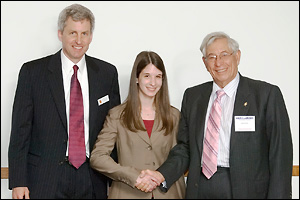
The announcement of the 2009 Fischell Fellow at the third annual Fischell Festival. Left to right: Professor and Chair William Bentley, Deborah Sweet (B.S. '06), and Dr. Robert E. Fischell (M.S. '53, physics). (Photo by Luisa DiPietro.)
The fellowship is a unique opportunity for talented and innovative graduate students interested in applied research and product design in the biomedical industry. It features a $35,000 12-month stipend, full tuition waiver, full health benefits, and is renewable for up to 5 years.
Sweet, who is currently enrolled in U-Md.'s Graduate Program in Bioengineering, is co-advised by bioengineering affiliate faculty members Professor Hamid Ghandehari (Department of Bioengineering, University of Utah) and Professor Peter Swaan (Department of Pharmaceutical Sciences and Center for Nanomedicine & Cellular Delivery, University of Maryland School of Pharmacy).
Sweet's winning proposal, "Anionic PAMAM Dendrimers for Oral Delivery of 5-Fluorouracil," describes how her proposed startup company, DendriPharm Systems, would develop an oral drug delivery system for chemotherapy drugs that are traditionally administered intravenously.
Dendrimers—nano-sized, highly branched polymers with defined, controllable structures—will serve as the drugs' base carrier. A dendrimer in a "starburst" configuration provides a large number of terminal groups, like a dense group of twigs at the end of a branch, to which not only therapeutics but also targeting and imaging agents can be attached. Dendrimers are capable of crossing biological barriers in the digestive tract and heading out into the rest of the body, taking their chemotherapy cargo with them. Many chemotherapy drugs are incapable of crossing these barriers on their own, which is why they must be delivered intravenously.
The advantage of using dendrimers as oral drug carriers, Sweet explains, benefits both the patient and the hospital. "A cancer patient could take pills to treat their cancer rather than sit for hours in the hospital receiving intravenous treatments," she says. "The regimen could be more flexible and even include at-home administration. This dramatically reduces treatment costs and lost time at work, and dramatically improves the quality of life for the patient."
Learn more about the Fellowship and current and past Fellows »
Published April 24, 2009
Recent Stories
Stories / May 26, 2026
Air Quality Study on 2023 Canadian Wildfires Reports New...

Stories / May 20, 2026
UMD Research to Study Aerosol Transmission of Respiratory...

Stories / May 13, 2026
2026 Invention of the Year: Engineering Projects Top List

Stories / May 13, 2026
Capstone Design Expo 2026: Students Solve for Maryland & Beyond

Stories / May 11, 2026
Undergrads Recognized at Annual Honors & Awards Celebration

Stories / May 8, 2026
Chemical Engineers Develop Treatments for Common Post-Operative...

Stories / Apr 22, 2026
Maryland Day @ DC Climate Week

Stories / Apr 21, 2026
NIH Invests $2M in Computational Research Models To Study Role...

Stories / Apr 16, 2026
UMD Team Wins Nuclear Energy Agency’s First Coding Competition

Stories / Apr 8, 2026
Recognizing Investments in Our Student Success
